
Introduction to Reverse Engineering and the FARO ScanArm
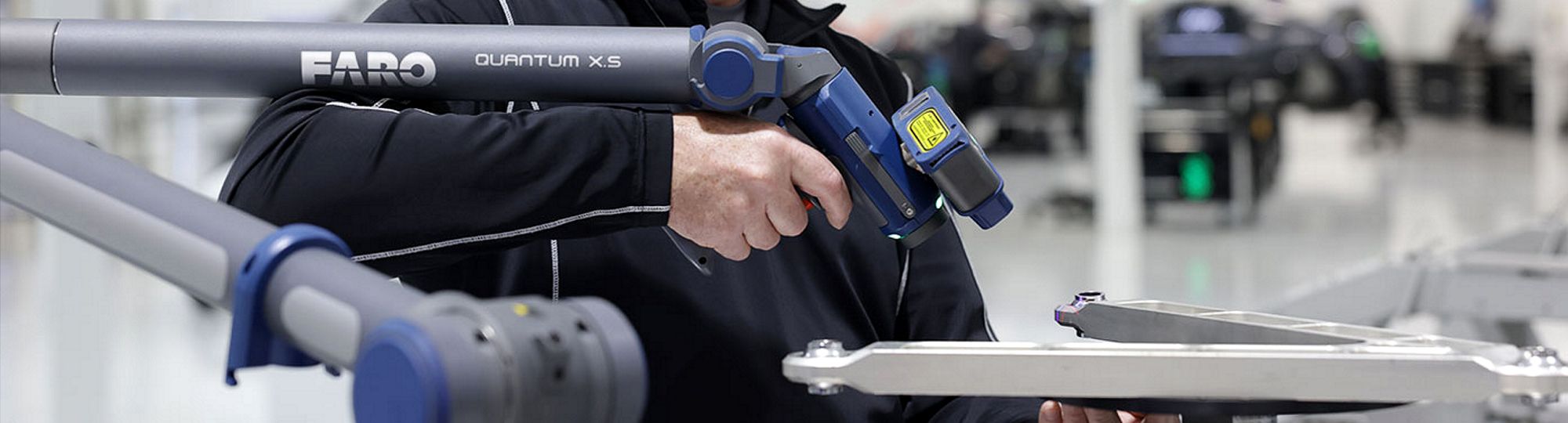
Hybrid Functionality for Maximum Efficiency
Organic shapes, intricate contours, and freeform designs are often difficult or impossible to measure using traditional tools - the FARO ScanArm changes that.
This portable measurement arm combines tactile probing and non-contact 3D scanning in a single system, making it particularly powerful for reverse engineering tasks where capturing both simple geometries and complex freeform surfaces is essential.
High-Accuracy Touch Probing for Geometrical Features
One of the standout advantages of the system is its ability to perform highly accurate touch probing. For geometrical features such as holes, planes, edges, and cylinders, tactile probing remains the gold standard. The ScanArm allows users to quickly gather precise data points, ensuring that critical dimensions are captured with confidence.
Capturing Complex Surfaces with Speed and Detail
Equally important is the ScanArm’s capability to scan complex surfaces. Organic shapes, intricate contours, and freeform designs are often difficult or impossible to measure using traditional tools. With its laser scanning functionality, the ScanArm rapidly captures dense point clouds, translating physical surfaces into detailed digital representations. This combination of speed and detail significantly reduces the time required to digitize parts, even those with highly complex geometries.
Reverse engineering goes beyond simple replication. It opens the door to design optimisation, digital transformation, and entirely new applications.
Portability and On-Site Flexibility
The portability of the system further enhances its value. Unlike fixed coordinate measuring machines (CMMs), the ScanArm can be used directly on the shop floor, in the field, or wherever the part is located. This flexibility minimizes downtime and eliminates the need to transport large or sensitive components.
Why Reverse Engineering Matters
Reverse engineering itself is vital across many industries. In manufacturing, it allows companies to reproduce legacy parts when original CAD files are unavailable. In product development, it enables engineers to analyze competitor products or iterate on existing designs. It is also widely used in maintenance and repair scenarios, where worn or damaged components must be recreated quickly to keep operations running..
Benefits Beyond Replication
The benefits of reverse engineering go beyond simple replication. It opens the door to design optimization, allowing engineers to improve performance, reduce weight, or adapt parts for new applications. It also supports digital transformation initiatives by converting physical assets into digital models, which can then be integrated into modern workflows such as simulation, additive manufacturing, or quality control.
Conclusion
By combining precise probing with high-speed scanning, the FARO ScanArm streamlines the entire reverse engineering process. Users can capture accurate data in a fraction of the time required by traditional methods, while maintaining the level of detail needed for high-quality CAD reconstruction. This efficiency not only accelerates project timelines but also reduces costs and improves overall productivity.
In a world where speed, accuracy, and adaptability are increasingly important, tools like the FARO ScanArm empower engineers to bridge the gap between physical and digital, turning real-world objects into actionable data with remarkable ease.

Published by iQlaser
Authorised Reseller · Southern Africa
iQlaser is the authorised FARO distributor in Southern Africa, supplying the full range of FARO measurement solutions - including the Quantum X Arm / FAROBlu Laser Line Probes / 8-Axis Max Integration - with local support, training, and after-sales service. Contact iQlaser to arrange a demonstration or request a quotation.
